


 LinkedIn
 Bay Exits Stealth With $50M to Vet AI Agent Actions
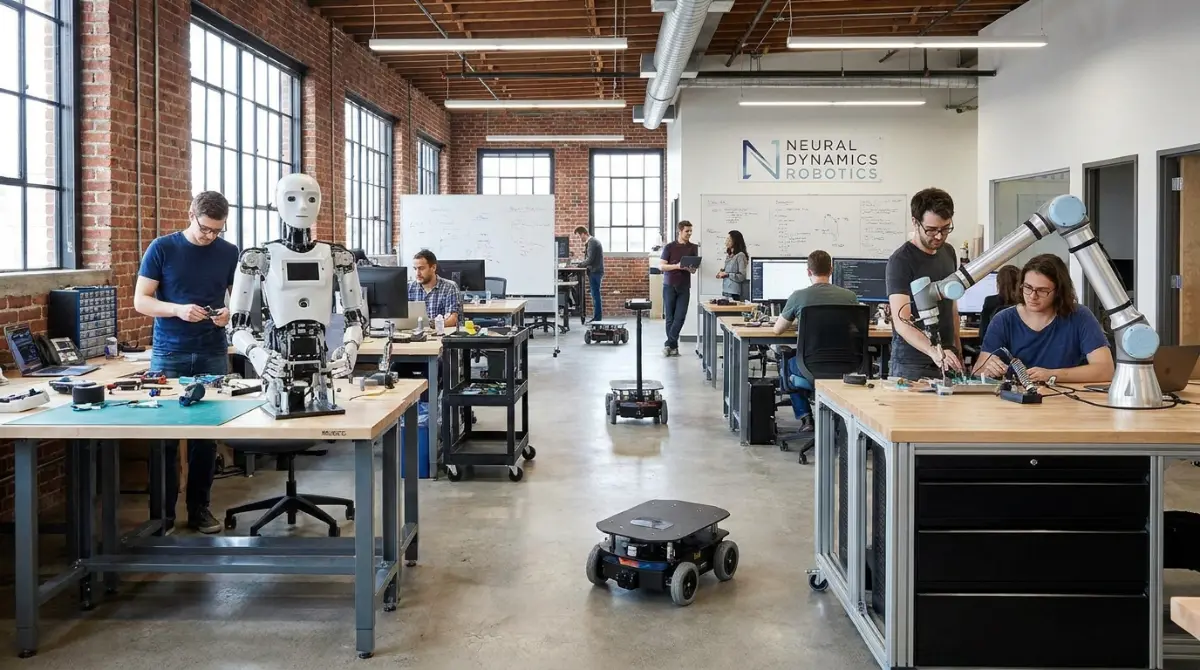
Inside the Physical AI Boom: 12 Robotics Startups
Twelve venture-backed startups are racing to take artificial intelligence off computer screens and into the physical world, engineering custom actuators, synthetic electronic skin, spatial foundation models, and autonomous manipulation systems to power general-purpose robots across industrial assembly lines.
Inioluwa Ademidun | · 13 min read

Teaching a neural network to write an essay on a computer screen takes seconds, but asking that same network to pick up an egg without cracking the shell has taken decades. For three years, venture capital firms poured tens of billions into foundational language models, watching software answer questions, write code, and compose poems inside browser tabs. Once those models conquered digital text, researchers confronted an uncomfortable boundary: intelligence trapped inside a screen cannot wash a dish, tighten a bolt on a car frame, or harvest a ripe tomato. The real world is not made of clean text tokens; it is made of friction, gravity, irregular shapes, and unyielding physics. That physical realization has triggered an industrial migration across Silicon Valley, Europe, and Asia. Technology investors are moving past disembodied software to back physical machine intelligence: the marriage of advanced spatial reasoning models with mechanical bodies capable of autonomous labor. Over the past twelve months, a new class of robotics ventures raised hundreds of millions of dollars to build the brains, senses, and muscles required for general-purpose machines. The physical hardware push arrives as manufacturing centers grapple with severe labor deficits, continuing deeptech investments we tracked when Human Capital raised $100M for physical automation.
The urgency behind this commercial push is demographic and economic. Across North America, Europe, and East Asia, industrial manufacturing, agricultural harvesting, and elder care facilities face acute staffing shortages that wage increases cannot solve. According to industrial research published by the International Federation of Robotics, worldwide installations of industrial machines hit fresh records this year, yet traditional robots remain blind, rigid arms bolted to factory floors that repeat programmed motions without understanding their surroundings. If a part shifts two centimeters to the left, a traditional factory robot smashes the component. Physical machine intelligence replaces rigid programming with real-time perception and adaptation. By training models on massive streams of video, tactile sensor readings, and physics simulations, engineers are building robots that see, feel, and decide how to manipulate unfamiliar objects in chaotic human environments. The commercial race has divided the startup world into two specialized camps: teams engineering the physical hardware bodies, actuators, and electronic skins, and teams building the multimodal foundation models that serve as the machine brain. Capital deployments across specialized automation hubs match patterns we monitored when a16z launched its dedicated Machine Age Fund.
The Sensory Layer: Giving Cold Steel Human Touch
Before a mechanical hand can manipulate fragile items, it must be able to feel. Traditional robotic grippers rely on crude optical cameras, guessing at grip pressure based on visual cues. When lighting conditions change or objects slip, the grip fails. These three startups are building the tactile nervous systems that give robots physical sensitivity:
1. MoSense (Shenzhen / San Francisco): Spun out of university materials laboratories, MoSense raised RMB 100M ($14M) to commercialize flexible electronic skin. The company prints micro-sensor arrays on flexible polymer sheets that wrap around robotic fingers and palms. These sensors measure shear force, localized pressure, and temperature changes at four thousand readings per second. When a humanoid hand touches a slippery glass bottle, MoSense electronic skin detects microscopic slippage in less than two milliseconds, adjusting motor torque before the glass falls. Tactile sensor advances were detailed in our analysis of MoSense raising RMB 100M for robot electronic skin.
2. GelSight (Waltham, Massachusetts): Born in academic research labs at MIT, GelSight builds elastomeric tactile sensors that use micro-cameras inside a soft synthetic gel pad to capture high-resolution 3D topography of any surface the sensor presses against. Instead of measuring crude pressure numbers, the robot brain sees the microscopic texture, ridges, and deformations of the object, allowing industrial robots to verify aerospace welds and detect micro-cracks in turbine blades with human-like touch.
3. SynTouch (Los Angeles, California): Founded by biomedical researchers, SynTouch manufactures biomimetic tactile sensors that replicate the mechanical properties of human fingertips. The BioTac sensor incorporates an elastic skin covering a fluid-filled cavity over a rigid bone-like core, measuring vibration, thermal conductivity, and contact forces simultaneously. The hardware enables robots to distinguish between silk, wood, and plastic purely by sliding a finger across the material.
The Spatial Brains: Training World Models and Navigation
Having capable mechanical hands is useless if the robot does not understand the physical rules of three-dimensional space. These three ventures are building the spatial perception models and simulation software that teach machines how the physical world behaves:
4. Machenta (Munich, Germany): Machenta secured $40M in Series A financing from prominent transatlantic venture funds to build high-fidelity virtual training worlds. Training robots in the real world is slow and dangerous: an experimental robot testing a heavy box drop can damage expensive components or injure human bystanders. Machenta builds photo-realistic physics simulations running on graphics processor clusters, allowing virtual robots to practice folding laundry, packing boxes, and navigating cluttered hallways millions of times in accelerated digital time before transferring learned neural weights to physical metal. Simulation architectures were explored in our report on Machenta securing $40M to train robots in virtual worlds.
5. TwelveLabs (San Francisco, California): Known for multimodal video comprehension, TwelveLabs adapted its Pegasus video models to translate human physical demonstrations into robotic manipulation policies. By parsing millions of hours of first-person YouTube videos showing people cooking, assembling flat-pack furniture, and operating hand tools, TwelveLabs extracts physical cause-and-effect patterns. A robot brain reads the video model embeddings to understand that turning a wrench clockwise tightens a threaded pipe, bypassing months of manual reinforcement training. Video training platforms were detailed in our review of TwelveLabs translating human video into robotic actions.
6. Skild AI (Pittsburgh, Pennsylvania): Founded by Carnegie Mellon computer vision researchers, Skild AI raised $300M at a $1.5B valuation to construct a universal foundation model for robotics. Unlike competitors who train models for specific humanoid chassis, Skild OmniBrain architecture is hardware agnostic. The model can be flashed onto a quadruped dog, a two-legged humanoid, or a single industrial robotic arm, allowing the machine to climb steep stairs, clear fallen debris, and manipulate tools without reprogramming baseline motor controllers.
Comparing Venture-Backed Physical AI Startups in 2026
| Startup Entity | Total Capital Raised | Primary Technological Focus | Hardware vs. Software | Commercial Deployment Focus |
|---|---|---|---|---|
| MoSense | ~$14M (RMB 100M) | Flexible tactile electronic skin arrays | Proprietary sensor hardware | Consumer electronics & warehouse hands |
| Machenta | $40M (Series A) | Physics simulation for motor training | Pure cloud simulation software | Industrial manufacturing & logistics |
| Destro AI | $8M (Seed) | Multi-robot autonomous swarm scheduling | Edge coordination software | High-throughput distribution hubs |
| Safeworld | $12M (Seed) | Collision avoidance & safety auditing | Auditing software & sensors | Human-robot collaborative shop floors |
| Norbert Health | $14M (Series A) | Autonomous nursing and clinical monitoring | Mobile wheeled clinical hardware | Hospital wards & assisted living |
| Skild AI | $300M (Series A) | Hardware-agnostic robot foundation model | Universal foundational software | Enterprise field robotics & inspection |
| Physical Intelligence | $400M (Series A) | General-purpose manipulation models (π0) | Embodied policy software | Domestic chores & commercial cleaning |
| Figure AI | $675M (Series B) | Full-stack humanoid robot manufacturing | Integrated humanoid hardware | Automotive assembly lines (BMW) |
The comparative data reveals the capital division across modern robotics. While full-stack hardware manufacturers like Figure AI require hundreds of millions of dollars to build assembly plants, component and software startups are raising targeted rounds to dominate specialized layers of the stack. An emerging robotics venture no longer needs to build its own motors, program its own vision models, and code its own pathfinding scripts from scratch. Founders can license drive bases from specialized platforms, install electronic skin from MoSense, train motor policies in Machenta simulations, and deploy universal brain models from Skild AI. That modularity is accelerating development schedules from multi-year research projects into rapid commercial deployments. Specialized robot funding was analyzed in our review of DeepSeek backing robotics startup Winverse.
Industrial Muscle: Full-Stack Humanoids and Logistics Swarms
Building the brain and senses is only half the battle; the machine must still perform heavy labor without tipping over or breaking parts. These three startups are building the full-stack mechanical bodies designed to replace human physical labor:
7. Destro AI (San Francisco, California): Operating in the high-pressure logistics sector, Destro AI secured $8M in seed funding to solve warehouse fleet bottlenecks. Instead of focusing on single expensive humanoids, Destro builds coordination software that controls fleets of mobile rovers and robotic sorting arms simultaneously. The system treats an entire ten-acre distribution center as a single physical computer: balancing package intake, directing autonomous pallet jacks, and adjusting sorting speeds to match truck departure schedules. Logistics fleet coordination was detailed in our report on Destro AI securing seed funding to coordinate warehouse robots.
8. Physical Intelligence / Pi (San Francisco, California): Led by veteran roboticists from UC Berkeley and Stanford, Physical Intelligence raised $400M from prominent backers to build π0 (pi-zero): a general-purpose physical policy model. The system operates across diverse hardware bodies, learning how to fold laundry, bus tables, and assemble electronics by treating motor commands as continuous tokens. The team demonstrated that a single neural model can control distinct robotic platforms, proving that physical manipulation can be generalized across tasks without requiring bespoke code for every action.
9. Figure AI (Sunnyvale, California): Figure AI represents the most ambitious full-stack humanoid builder in North America. Raising $675M from investors including Nvidia, OpenAI, and Microsoft, Figure designs both the mechanical skeleton and the electrical actuation of its Figure 02 humanoid. Standing five feet six inches tall and weighing seventy kilograms, the machine operates on factory floors: placing sheet metal components into automotive presses at BMW production plants. Powered by custom high-torque electric actuators and on-board vision reasoning, Figure 02 demonstrates that bipedal humanoids can work alongside human technicians on active assembly lines.
Specialized Application Layers: Healthcare, Inspection, and Safety
General-purpose humanoids capture public attention, but specialized robots designed for specific commercial environments are generating verified business income today. These final three startups are proving commercial utility in demanding enterprise sectors:
10. Norbert Health (New York / Paris): Norbert Health raised $14M to deploy autonomous monitoring rovers into hospital wards and nursing homes. Built with contactless medical radar and thermal vision sensors, the machine moves quietly down hospital corridors: scanning patient vital signs, measuring respiration rates, and detecting fall hazards without touching human patients. The platform relieves exhausted nursing staff of routine hourly checks, freeing human medical workers to focus on urgent clinical care. Healthcare automation platforms were examined in our review of Norbert Health securing Series A funding for nursing robotics.
11. Safeworld (San Francisco, California): As autonomous machines enter shared human workspaces, preventing physical injuries is a legal necessity. Safeworld raised $12M to build continuous auditing and safety interception software for physical automation. Safeworld installs multi-spectral sensor perimeters around collaborative robot work cells, monitoring the velocity and proximity of human workers. If a mechanical arm swings toward an approaching technician, Safeworld intercepts the motor controller at the hardware level, cutting power within five milliseconds to prevent crushing accidents. Safety auditing systems were detailed in our analysis of Safeworld raising $12M to audit generative robotics.
12. Mach9 (Pittsburgh, Pennsylvania): Mach9 secured $34M in Series A funding to turn raw physical sensor scans into engineering models. The company software processes visual and lidar telemetry collected by mobile inspection robots, converting real-world scans of bridges, electrical substations, and rail lines into millimeter-accurate computer-aided design (CAD) files in minutes. By automating spatial data analysis, Mach9 allows civil infrastructure owners to inspect physical assets without sending human inspection crews into dangerous tunnels or high-voltage facilities. Automated infrastructure scanning was explored in our report on Mach9 securing $34M for civil engineering CAD tools.
The Actuator Deficit: Where Silicon Meets Physics
While software models and perception systems have advanced rapidly, the physical robotics boom confronts an unyielding mechanical bottleneck: electric actuators. In human biology, skeletal muscles provide high torque, compliance, and explosive power while consuming calories with astonishing energy thrift.
In mechanical engineering, replicating the power density of human muscle requires heavy copper windings, high-grade rare-earth magnets, and precision planetary gearboxes known as harmonic drives. The global supply chain for precision harmonic drives is concentrated in a handful of specialized manufacturers in Japan and Germany, creating waiting periods of up to six months for custom gear assemblies. Furthermore, powering twenty-eight electric motors simultaneously across a walking humanoid drains lithium battery packs quickly: most bipedal prototypes operate for barely two to four hours before requiring a battery swap. Startups like Figure and Apptronik are pouring capital into proprietary motor design: engineering axial-flux electric motors that generate higher torque per kilogram while shedding excess thermal heat. Until actuator power density doubles and battery chemistry advances, physical robots will remain constrained by weight and operational stamina. Mechanical supply chain constraints were examined in our review of Foundry Robotics raising $100M for autonomous factory lines.
The Data Scarcity Problem: Why Text Scraping Fails
The secondary hurdle slowing physical machine intelligence is data collection. To train a language model, research labs scraped petabytes of public text from internet web pages, feeding billions of sentences into server clusters at low expense.
There is no public internet repository of physical manipulation data. You cannot scrape the sensation of threading a needle or balancing on an icy sidewalk from a website. Collecting physical training data requires operating real machines: hiring human teleoperation workers to wear virtual reality headsets and haptic gloves, manually controlling robots through thousands of hours of repetitive tasks to record joint angles, motor torques, and visual feeds. Startups like MaxInsights and Mecka AI emerged specifically to solve this data deficit: setting up physical training warehouses where human workers guide robots through thousands of daily household chores to generate structured training datasets. The cost of collecting physical action data is hundreds of times higher than downloading text files, meaning that startups with superior simulation environments and capital reserves hold an immense advantage. Robot training data acquisition was detailed in our report on MaxInsights raising $30M to convert household chores into robot data.
The Long-Term Assessment on Physical Artificial Intelligence
The rise of physical machine intelligence marks the beginning of the most profound industrial transformation since the invention of the steam engine. For three decades, the digital economy operated as an isolated realm: creating wealth inside computer networks while leaving the physical world of roads, factories, and farms largely unchanged.
The twelve startups profiled in our review prove that the boundary separating software code from physical matter has dissolved. By combining advanced spatial foundation models with sensitive electronic skin, high-torque actuators, and rigorous safety controls, these ventures are constructing the machines that will clean our hospitals, harvest our food, assemble our electronics, and maintain our critical infrastructure. The road ahead will require overcoming mechanical bottlenecks, managing supply chain constraints, and ensuring physical safety in human workspaces. The direction of travel is undeniable: the future of artificial intelligence does not belong inside a glowing screen, but in the capable, tireless machines that walk beside us in the physical world.
Read More on TechRobust:

Inioluwa Ademidun
Inioluwa Ademidun
Expertise:African Tech Ecosystem, Early-Stage Startups, Emerging Market Dynamics, Venture Capital & Tech Reporting, Product Management
Award:TechRobust Contributor of the Year 2025
Inioluwa is a Senior Product Manager by day and an investigative technology reporter by night, bridging the gap between scalable software architecture and high-impact journalism. She delivers deep-dive analysis on venture-backed founders, regulatory shifts, and grassroots tech ecosystems across Africa and global emerging markets.
Related Stories
Bay Exits Stealth With $50M to Vet AI Agent Actions Serve Robotics Launches Modular Platform as AWS for Robots
 Ballistic Ventures Targets $490M for AI Cybersecurity