
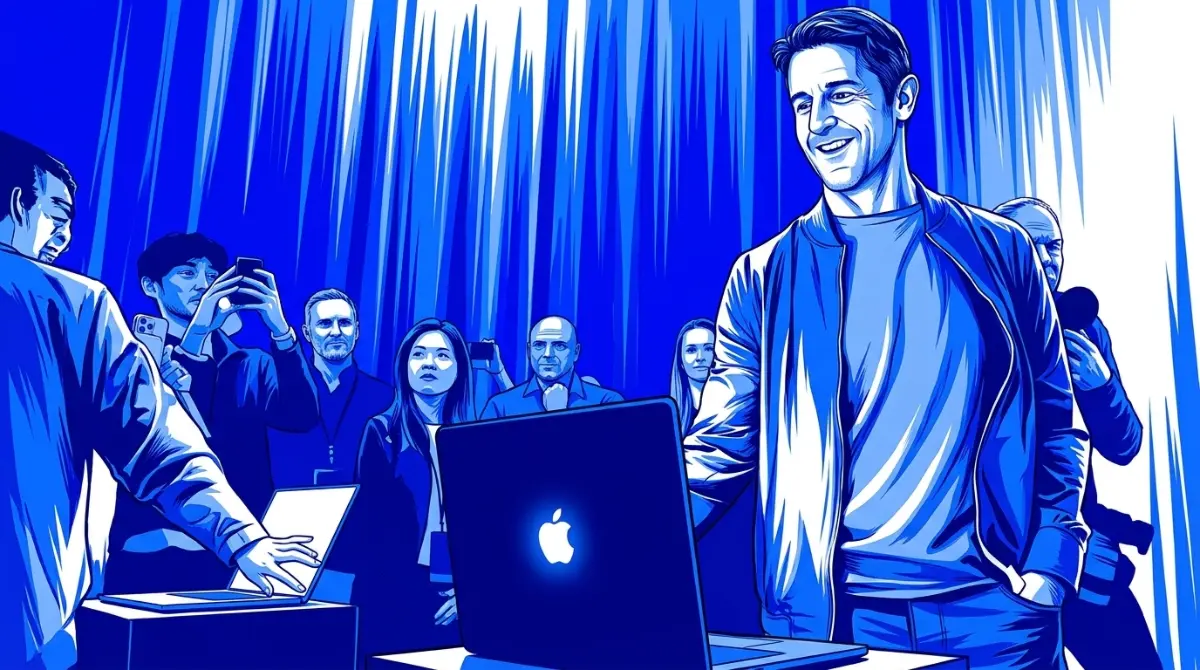


Apple CEO: We Will Not Ship AI for AI's Sake
Apple Chief Executive Officer John Ternus defended Cupertino hardware philosophy, stating the company will not ship machine tools purely to follow market fads, prioritizing consumer devices while former leader Tim Cook advises on government policy.
Umar Abubakar | · 9 min read

Technology corporations spent three years cramming machine reasoning models into every consumer screen, dropdown menu, and household device. Executives in Silicon Valley acted as if adding conversational sidebars to word processors and calculators was an emergency requirement. When a product designer proposed a device, board directors demanded to know where the automated chatbot would live. Apple Chief Executive Officer John Ternus broke with that frenzy during an interview in Los Angeles. Speaking following the introduction of the touchscreen MacBook Pro, Ternus stated that Apple refuses to ship artificial intelligence purely to satisfy industry buzz. He explained that when Apple does its job correctly, people love using physical devices without stopping to think about the mathematical models running beneath the glass. The stance marks a sharp philosophical departure from competitors who treat machine learning as an end in itself. The interview arrives as Apple reorganizes executive responsibilities following corporate leadership transitions, continuing management shifts we tracked when Apple appointed John Ternus as chief executive officer.
The comments from Ternus deliver a clear look at how Cupertino views the computational boom. While rival platforms rushed to market with experimental chatbots that hallucinate facts and interrupt user workflows, Apple is anchoring its identity in consumer electronics. Ternus, who spent twenty-five years leading hardware engineering teams before taking the corporate helm, argued that consumers do not purchase computers because they want to admire abstract neural architectures. Customers buy phones and laptops to complete creative projects, communicate with family members, and manage daily responsibilities. If an automated tool improves photo editing, reduces battery consumption, or organizes notifications without demanding constant user supervision, it earns a place in the operating system. If an algorithm serves only as a promotional demonstration that distracts from the physical device, Apple will keep it in research laboratories. The disciplined hardware stance comes as personal computer makers overhaul computing lines, continuing desktop product benchmarks we followed in our Apple M6 Mac mini hardware review.
The Doctrine of Invisible Computing and Steve Jobs Legacy
To inspect why Ternus is resisting market trends, one must evaluate the product philosophy established by Apple co-founder Steve Jobs. Jobs famously insisted that technology should stand at the intersection of liberal arts and engineering, arguing that hardware and software must disappear into a seamless tool that feels natural to human hands.
Ternus explicitly referenced that heritage, noting that his daily passion centers on finished products rather than financial spreadsheets. When competitors announce artificial intelligence integrations, they often present the technology as an active collaborator that requires conversation: prompting users to type questions into blank search boxes or review paragraphs of synthetic text. Apple views that approach as clunky. Invisible computing means an operating system uses machine reasoning behind the scenes: adjusting display refresh rates, canceling background microphone noise, sorting family photographs, and prioritizing urgent text alerts without the user ever opening a specialized chat portal. The user experiences speed and simplicity, remaining unaware of the millions of floating-point calculations executing inside local neural processing units. The integration of silicon architecture with physical hardware was detailed in our analysis of Apple unveiling M6 processors inside MacBook Pro and iMac computers.
The Touchscreen Mac: Breaking Historical Taboos
The Los Angeles hardware presentation proved that Ternus is willing to rethink long-standing corporate orthodoxies when consumer demand justifies change. For two decades, Apple leadership dismissed touchscreen laptops, with executives famously claiming that lifting a hand to touch a vertical laptop display causes arm fatigue.
Ternus approved the development of touchscreen MacBook Pro models because modern input methods evolved. Creative professionals who grew up using iPads and smartphones expect to pinch, zoom, and annotate drawings directly on laptop glass. Apple engineered specialized display hinges with magnetic dampening to ensure the screen remains rigid when tapped by fingers or an Apple Pencil. By pairing touch input with custom trackpad gestures and mechanical keyboards, Apple gave creative workers multiple input options without turning macOS into a cluttered mobile interface. The willingness to abandon past corporate dogma to deliver functional hardware highlights Ternus practical engineering mindset. Hardware comparisons across modern creative workstations were explored in our analysis of Dell laptops competing against Apple creative hardware.
Comparing Big Tech Artificial Intelligence Integration Philosophies
| Technology Platform | Primary AI Architecture | User Interaction Style | Monetization Model | Hardware Dependency |
|---|---|---|---|---|
| Apple (Ternus Era) | On-device neural engines + Private Cloud | Invisible background system features | Premium physical hardware sales | Proprietary Apple Silicon required |
| Microsoft (Copilot) | Remote Azure cloud clusters + OpenAI | Persistent conversational sidebars & bots | Monthly enterprise software subscriptions | Hardware agnostic web and Windows |
| Google (Gemini) | Massive multi-tenant server facilities | Conversational search overrides & tools | Digital advertising & cloud API tiers | Web browsers & Pixel Android models |
| Meta (Muse) | Open-weights + hyperscale inference | Proactive background social agents | Targeted advertising data funnels | Smart glasses & mobile social apps |
| Samsung (Galaxy AI) | Hybrid Google Cloud + Qualcomm NPU | Standalone photo & translation utilities | Device bundling with future paywalls | Galaxy consumer smartphone lines |
The comparative data illustrates Apple distinctive market position. Competitors like Microsoft and Google treat software models as primary destinations, selling monthly subscriptions or mining consumer conversations to target digital advertisements. Apple treats software models as an unseen lubricant that makes premium hardware delightful to own. Because Apple makes its profit from selling high-margin laptops, phones, and watches, it does not need to monetize user conversations through paid subscription tiers. That financial model allows Apple to prioritize privacy and quiet utility over flashy conversational tricks. Enterprise computing battles between platform giants match developments we analyzed when Apple targeted enterprise computing costs with Mac hardware.
The Tim Cook Advisory Role and Political Navigation
Managing a global corporation with a three-trillion-dollar valuation requires intense diplomatic skill. While Ternus focuses his daily energy on industrial design, hardware engineering, and software integration, former Chief Executive Officer Tim Cook continues serving as a strategic counselor on corporate governance and international policy.
Ternus confirmed that Cook remains available to advise on sensitive geopolitical matters whenever requested. Cook built relationships with government leaders across Washington, Brussels, and Beijing, shielding Apple from punitive trade tariffs and foreign regulatory crackdowns. Ternus acknowledged that he has not yet met with United States political leadership, but stated that Apple will continue engaging constructively with government officials worldwide. Navigating American industrial policy is urgent: antitrust regulators continue investigating the iOS App Store, while trade officials debate import tariffs on consumer electronics manufactured overseas. Having Cook handle high-level diplomacy allows Ternus to dedicate his time to what he knows best: building beautiful computers that consumers love. Corporate regulatory pressures and App Store rules were examined in our review of Apple App Store adjustments protecting revenue margins.
Memory Component Inflation and the Twenty-Five Billion Bill
A severe operational challenge confronting Ternus is surging semiconductor component costs. The worldwide race to construct computing server facilities created a severe shortage of high-bandwidth memory, prompting semiconductor foundries to redirect cleanroom capacity away from standard mobile storage chips.
Industry research shows that Apple projected NAND flash and DRAM procurement expenses could climb to $25B this year as memory prices surge sixty percent. In consumer electronics manufacturing, absorbing billions in component price hikes threatens profit margins. Competitors have responded by raising retail prices on smartphones and laptops or cutting standard storage tiers. Ternus engineering teams have taken a different path: optimizing memory compression algorithms inside macOS and iOS to ensure that devices deliver exceptional performance on sixteen gigabytes of baseline memory. By avoiding steep retail price hikes, Apple preserves customer loyalty during an economic period when household budgets are strained by inflation. Device durability and supply chain balances were analyzed in our review of the iPhone flagship review and upgrade guide.
Lessons from the Foldable Hinge: Balancing Speed with Durability
Ternus disciplined approach to product releases was tested by the recent introduction of the $1,999 iPhone Duo, Apple first folding smartphone. Despite years of laboratory testing, early retail units suffered from display cracking along the central hinge seam, forcing Apple to issue free replacements through AppleCare counters.
The display cracking reports, labeled Crackgate across social networks, proved that mechanical innovation carries physical risks. Ternus addressed the problem with engineering pragmatism rather than public relations spin: dispatching failure analysis teams to Samsung Display cleanrooms to tighten hinge mechanical clearances and adjust internal support bars. Rather than rushing experimental form factors to store shelves simply to claim industry firsts, Apple intends to refine hardware until durability satisfies long-term consumer expectations. Learning from early mechanical failures ensures that future product lines: including augmented reality glasses and smart home displays: arrive with the physical durability customers expect from Cupertino. The mechanical causes of display cracking were detailed in our teardown report on iPhone Duo hinge teardown uncovering causes of display failure, alongside corporate replacement policies tracked when Apple confirmed iPhone Duo screen cracks and offered free swaps.
Software Refinement: Speed Over Synthetic Novelty
The product philosophy championed by Ternus is visible in recent operating system updates. In macOS 27 Golden Gate and iOS 27, Apple prioritized system responsiveness, battery conservation, and interface consistency over generative parlor tricks.
Rather than cluttering the desktop with automated writing assistants that users rarely request, Apple focused on practical improvements: speeding up application launch times, enhancing local spotlight search indexing, and introducing automated window tiling. The company added strict privacy controls, ensuring that when on-device models process sensitive documents, personal records remain sandboxed in secure memory enclaves. Third-party developers praise this approach because it gives them stable operating system foundations to build specialized applications, rather than competing against built-in corporate bots. System speed optimizations across consumer platforms were documented in our report detailing how Apple updated iOS to improve performance across thirty system areas, alongside retail security tools explored when Apple built diagnostic scanners for retail counters.
The Long-Term Outlook for John Ternus Apple
John Ternus interview delivers a reassuring message to millions of Apple customers worldwide: the world most valuable technology company will not abandon its core identity to chase speculative market fads. In an industry where competitors act as if conversational software has rendered physical devices obsolete, Apple understands that human beings live in a physical world.
People care about the weight of an aluminum laptop in their backpack, the tactile click of a keyboard, the clarity of an OLED display under direct sunlight, and the battery life that lasts through a cross-country flight. Artificial intelligence will continue improving those physical tools, but it will remain an unseen servant rather than the headline act. By rejecting the urge to ship machine models for the sake of marketing presentations, John Ternus is keeping Apple grounded in the product excellence that Steve Jobs demanded. In the emerging computational era, true leadership belongs not to the companies that shout the loudest about artificial intelligence, but to the disciplined builders who craft tools so intuitive, reliable, and quiet that they become an inseparable part of everyday human life.
Read More on TechRobust:
Umar Abubakar
 LinkedIn
Umar Abubakar
Expertise:Editorial Leadership, Product Design (UI/UX), Digital Media Strategy, Technology Systems, Product Architecture
Award:TechRobust Visionary Leader of the Year 2025
Umar serves as Editor-In-Chief of TechRobust, combining editorial vision with senior product design expertise to shape how modern technology stories are built, packaged, and told. Overseeing all editorial verticals, he directs coverage across global and regional tech industry while applying deep design thinking to publication strategy and reader experience.