
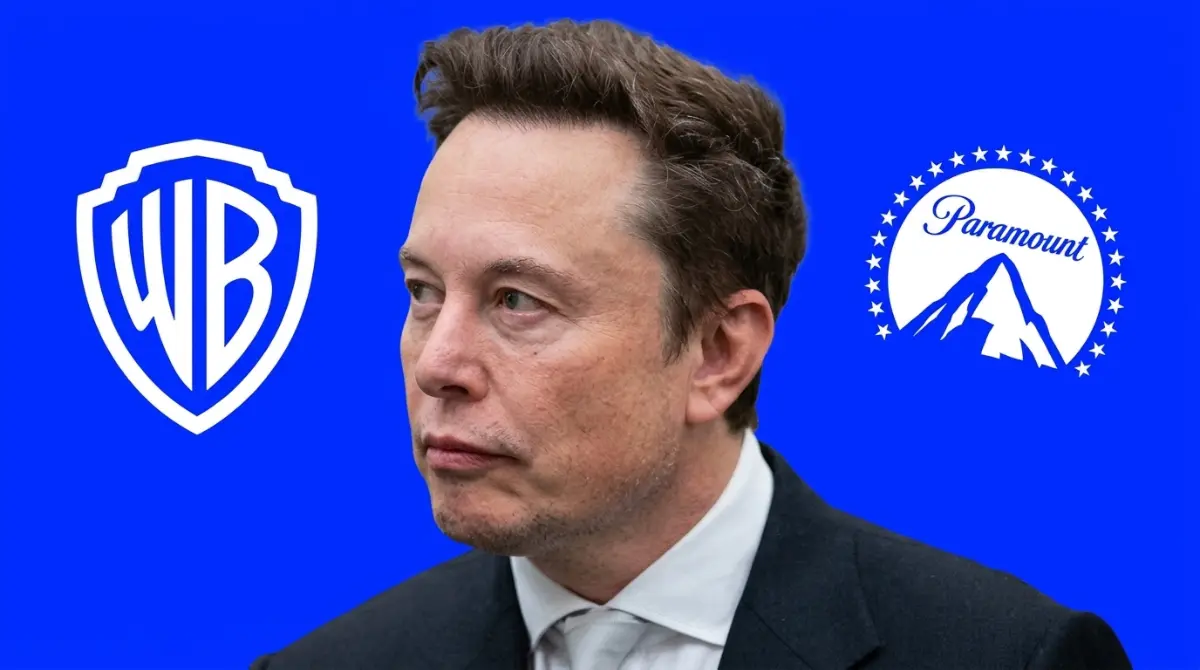


Elon Musk Invests $1B in Skydance Media Giant
Elon Musk invested $1B into Skydance Media as David Ellison completes the takeover of Paramount Global, cementing an alliance with Oracle founder Larry Ellison that bridges Hollywood studios with social network distribution and computational reasoning clusters.
Inioluwa Ademidun | · 10 min read

Film studios and technology balance sheets are merging into a single corporate operation. For decades, traditional Hollywood entertainment companies relied on box office ticket lines, cable television packages, and syndicated broadcast rights to finance production budgets. Silicon Valley treated entertainment as an outside novelty, buying film rights for streaming catalogs while keeping corporate balance sheets separate from studio soundstages. That separation ended on Thursday, October 22, 2026. Financial reporting confirmed that Elon Musk completed a personal equity investment of roughly $1B into Skydance Media. The transaction positions the billionaire entrepreneur as a significant equity participant in the media enterprise directed by David Ellison, which recently completed its landmark merger with Paramount Global. The cash injection strengthens a long-standing financial partnership between Musk and David father, Oracle co-founder Larry Ellison, while giving Musk direct strategic ties to historic television franchises, motion picture studios, and broadcast networks. The investment arrives as corporate leaders evaluate capital outlays across industrial operations, an economic reality examined when Musk corporate spending ambitions faced financial scrutiny.
The deal delivers an immediate capital cushion for Skydance Media as the studio manages billions in debt obligations inherited from the Paramount transaction. Earlier this month, Skydance finalized its takeover of Paramount Global, creating an entertainment powerhouse that combines theatrical motion picture franchises like Mission Impossible and Top Gun with CBS broadcast news, Nickelodeon, and the Paramount Plus streaming service. Larry Ellison personally guaranteed $40B in equity financing to help his son David secure control of the entertainment empire, providing the financial backbone for the studio restructuring. Bringing Musk into the shareholder syndicate deepens a relationship that spans decades of mutual business deals. The transaction comes barely forty-eight hours after media mogul John Malone publicly suggested that Musk would participate in Skydance capital structure, pointing out that cross-investments between the Ellison family and Musk have consistently surfaced during major corporate acquisitions. How large conglomerates navigate corporate ownership structures was detailed in our review of regulators demanding verified ownership records for private assets.
The Long History of Financial Support Between Musk and Ellison
To understand why Musk committed $1B to Skydance, one must inspect the personal bond uniting Musk and Larry Ellison. In American corporate history, few billionaires have supported each other financial ventures with equal consistency. In 2018, when federal securities regulators forced Musk to add independent directors to Tesla corporate board following disputes over public disclosures, Larry Ellison stepped forward to purchase $1B in Tesla stock and joined the board, serving as a trusted counselor until 2022.
The financial backing flowed in both directions. In 2022, when Musk organized the $44B private buyout of social media network Twitter, Larry Ellison provided another $1B personal equity check to anchor the takeover syndicate, describing Musk as a close personal friend whose vision for free expression deserved financial backing. When Skydance needed capital to absorb Paramount multi-billion-dollar corporate debt load, David Ellison approached Musk for investment support. Malone noted during an appearance on television network CNBC that Larry Ellison funded portions of his Skydance equity commitments using gains accumulated from his early Tesla investments. Seen through that lens, Musk $1B check represents the continuation of an informal family capital network that allows both tech titans to move multi-billion-dollar sums without consulting outside institutional boards. The capital discipline required to manage large corporate networks was explored in our analysis of The Boring Company securing international growth capital.
Studio IP and Content Pipelines for Social Video and Synthetic Models
Beyond personal friendships, the commercial logic behind the investment centers on digital video distribution and machine training data. Musk owns social platform X, which has spent twenty-four months attempting to transform itself from a text-based town square into a video streaming hub. Despite hiring popular video creators, X has struggled to license premium theatrical movies, live sports broadcasts, and scripted television dramas that keep viewers engaged for hours.
Partnering with Skydance Media gives Musk direct access to one of the largest intellectual property archives in global entertainment. Paramount owns historic franchises including Star Trek, The Godfather, Indiana Jones, and SpongeBob SquarePants, alongside CBS Sports rights covering NFL football and college basketball championships. Furthermore, Musk private research laboratory, xAI, requires petabytes of high-definition video, audio dialogue, and screenplay text to train its Grok models on human physical interactions and conversational speech. Accessing licensed studio video libraries gives xAI clean, copyright-cleared training datasets that avoid the intellectual property lawsuits currently threatening competing software laboratories. The intersection of entertainment media and algorithmic technology was highlighted when video platforms adjusted advertising rules for documentary releases.
Comparing Major Tech Titan Media and Entertainment Acquisitions
| Investor or Platform | Target Media Asset | Capital Commitment | Primary Intellectual Property | Strategic Corporate Objective |
|---|---|---|---|---|
| Elon Musk | Skydance Media / Paramount | $1B (Personal Equity) | Mission Impossible, Star Trek, CBS Sports | Content feeds for X and clean training video for xAI |
| Larry Ellison Family | Paramount Global Buyout | $40B (Equity Guarantee) | Paramount Pictures, CBS Network, Pluto TV | Building a dominant next-generation studio conglomerate |
| Amazon | Metro-Goldwyn-Mayer (MGM) | $8.5B (Corporate Cash) | James Bond, Rocky, historical MGM film vault | Bolstering Prime Video subscriber retention |
| Apple | Apple Studios Productions | ~$10B+ Annual Spend | Original scripted series and live sports | Driving hardware device ecosystem lock-in |
| Netflix | Roald Dahl Story Company | ~$700M (Cash) | Willy Wonka, Matilda, children literature | Building proprietary family animation franchises |
The comparison table demonstrates how technology wealth has taken control of traditional entertainment. While Amazon and Apple spent corporate cash to build streaming catalogs, the Ellison family and Musk are purchasing controlling equity in heritage Hollywood studios directly. The convergence allows tech entrepreneurs to dictate how studio films are produced, distributed, and monetized in digital formats. Shifting consumer video consumption patterns were detailed in our report on Netflix cutting corporate positions to protect streaming margins.
Defending Against Critical Documentaries and Media Coverage
Industry analysts have pointed to another immediate incentive behind Musk investment: editorial influence. Over the past twenty-four months, independent filmmakers and investigative journalists produced multiple documentaries examining Musk workplace practices, aerospace launch safety records, and personal political endorsements.
One prominent documentary project, which explored Musk acquisition of Twitter and subsequent corporate reorganizations, was shopped to multiple major streaming distributors, including Paramount Plus. Media reporters noted that securing a $1B equity position in Skydance gives Musk an influential voice in the boardroom that oversees Paramount content distribution. While studio executives maintain that editorial independence will be protected, having an influential billionaire on the cap table makes commissioning or distributing hard-hitting investigative documentaries about his companies far less likely. Musk has consistently used his wealth to buy platforms where his businesses are criticized, purchasing Twitter to dismantle content moderation rules that had previously penalized his account. Gaining an equity foothold in an established legacy studio provides a similar protective shield against critical Hollywood productions. Corporate communications and political positioning were analyzed in our coverage of Meta youth safety legal settlements.
The Staggering Paramount Debt Load and Financial Risk
While the union between Musk and Skydance creates exciting distribution possibilities, the transaction carries serious balance sheet risks. Paramount Global entered the merger burdened with more than $14B in long-term debt, accumulated through decades of declining linear television subscriptions and costly streaming investments.
The cable television channels that once generated billions in cash flow for Paramount: MTV, Comedy Central, VH1, and BET: are bleeding viewers as young audiences spend their entertainment hours on YouTube, TikTok, and video games. At the same time, running a subscription streaming platform like Paramount Plus remains an expensive enterprise that burns hundreds of millions annually in content acquisition and server hosting costs. David Ellison has pledged to eliminate at least $2B in overlapping corporate costs through staff reductions and facility consolidations. If advertising revenues weaken and cord-cutting accelerates, servicing Paramount debt will consume significant operating income, leaving less capital for film productions. Musk $1B check helps cushion those obligations, but public equity markets will scrutinize whether the combined company can stabilize cash flows without requiring additional capital injections. Macroeconomic concerns regarding corporate debt were examined in our review of economists warning of systemic risks from concentrated capital.
Antitrust Scrutiny and Media Consolidation Boundaries
The financial alliance between Musk, Larry Ellison, and David Ellison will inevitably attract regulatory inspection. In Washington and Brussels, competition regulators have raised alarms over the concentration of media ownership in fewer corporate hands.
The Federal Communications Commission and the Department of Justice review media acquisitions to ensure that single entities do not control an excessive share of local television stations or national broadcast bandwidth. CBS operates owned-and-operated broadcast stations in major metropolitan media markets across the United States. If regulators determine that Musk equity holding in Skydance gives him operational influence over CBS News coverage while controlling social platform X, watchdogs could demand behavioral remedies or board recusal covenants. Democratic lawmakers on Capitol Hill have voiced concern that billionaire control over traditional newsrooms threatens journalistic independence, pointing to changes at the Los Angeles Times and The Washington Post following billionaire acquisitions. Skydance legal counsel maintains that Musk holding is a passive equity investment without formal board governance seats, blunting potential regulatory challenges. The political sensitivities governing corporate technology expansions were explored in our analysis of negotiations for semiconductor manufacturing in Texas.
The Dream of the Everything App Takes Physical Form
Musk stated ambition for social network X has always been creating what he terms an everything app: a universal mobile platform modeled after WeChat in China, uniting messaging, mobile payments, ride-hailing, e-commerce, and video entertainment.
For two years, critics pointed out that building an everything app requires more than software updates; it demands high-value content that gives consumers a reason to open the application twenty times a day. By partnering with Skydance Media, Musk moves closer to that vision. X could integrate Paramount Plus streaming bundles, broadcast live NFL games through X video players, and offer interactive polling during live CBS news broadcasts. Furthermore, users could purchase movie tickets, stream television episodes, and tip content creators using payment rails currently being developed inside X Payments. Gaining an equity stake in a heritage studio gives Musk the cultural programming needed to attract mainstream consumers who care little about technology politics but love watching movies and sporting events. Platform expansion strategies across global financial sectors were detailed in our review of Revolut challenging traditional banking giants.
The Future of Technology Driven Entertainment
Elon Musk $1B investment in Skydance Media confirms that the boundary between technology platforms and Hollywood studios has dissolved permanently. The era when movie executives in Los Angeles operated independently of computer engineers in Silicon Valley is over.
As streaming economics compress and production costs climb, legacy entertainment companies require the capital reserves, cloud infrastructure, and computational tools that only tech billionaires can supply. In return, technology moguls gain the storytelling prestige, intellectual property libraries, and cultural influence that software code alone cannot create. By uniting with David and Larry Ellison at Skydance, Musk has secured an influential position in the entertainment business. The coming years will prove whether Silicon Valley capital can revitalize a century-old movie studio, or whether the harsh realities of Hollywood accounting will humble another tech titan who thought running an entertainment empire was easy. Public equity market expectations were evaluated in our report on Wall Street corporate earnings pressure, while automotive advances were tracked when Tesla announced rocket thruster integrations.
Read More on TechRobust:
Inioluwa Ademidun
 LinkedIn
Inioluwa Ademidun
Expertise:African Tech Ecosystem, Early-Stage Startups, Emerging Market Dynamics, Venture Capital & Tech Reporting, Product Management
Award:TechRobust Contributor of the Year 2025
Inioluwa is a Senior Product Manager by day and an investigative technology reporter by night, bridging the gap between scalable software architecture and high-impact journalism. She delivers deep-dive analysis on venture-backed founders, regulatory shifts, and grassroots tech ecosystems across Africa and global emerging markets.