
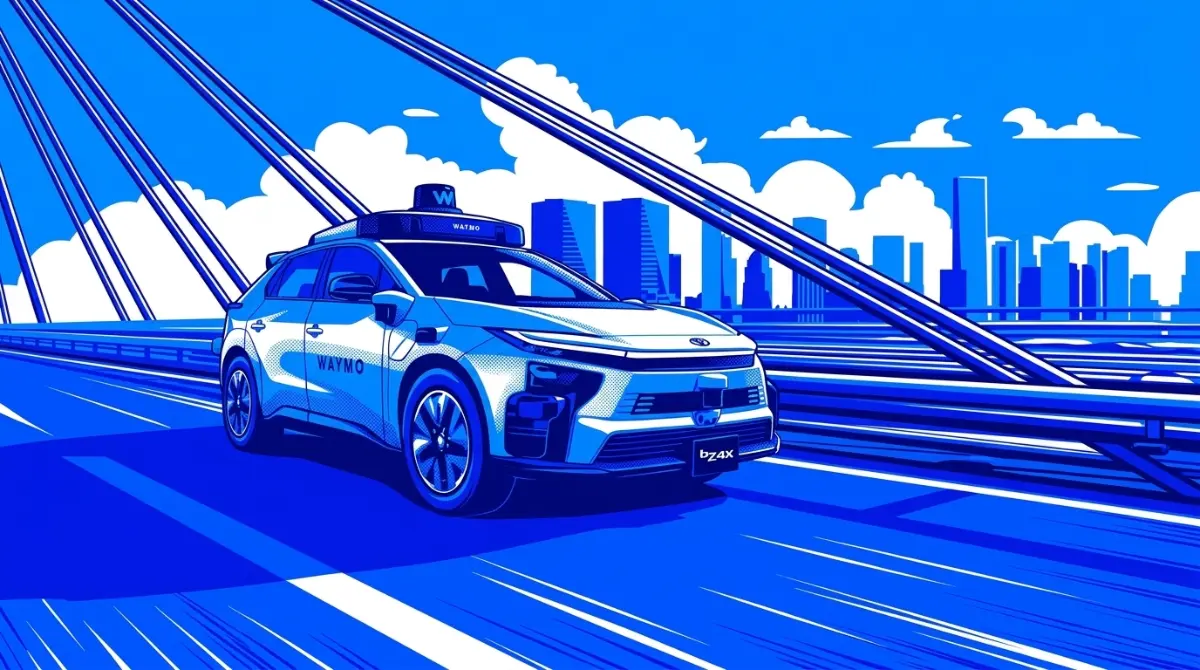


Waymo Taps Toyota bZ4X for Tokyo and London Robotaxis
Alphabet autonomous driving unit Waymo selected the electric Toyota bZ4X SUV as its international fleet platform, building custom vehicles on Japanese assembly lines for a 2027 Tokyo debut before rolling into the United Kingdom.
Inioluwa Ademidun | · 8 min read

Scaling autonomous passenger cars across foreign cities requires more than downloading software onto imported vehicles. When a self-driving company attempts to deploy commercial robotaxis in Tokyo or London, vehicles must navigate narrow historic lanes, operate with right-hand steering controls, and comply with strict national automotive safety regulations. Retrofitting existing American consumer cars at domestic ports adds thousands of dollars in mechanical labor and delays international expansion. Alphabet autonomous driving company Waymo resolved that international production bottleneck on Friday, October 30, 2026. The company announced that it selected the electric Toyota bZ4X sport utility vehicle as its international vehicle platform, expanding a partnership signed with the world largest automaker last year. Toyota will manufacture a customized version of the electric SUV with the Waymo Driver self-driving hardware suite integrated directly on assembly lines in Japan. A commercial test fleet will begin street operations in Tokyo in 2027, followed by deployments across the United Kingdom and additional international markets. The international manufacturing agreement arrives as autonomous transport companies prepare global commercial services, continuing fleet developments we tracked when Waymo launched driverless airport rides in Las Vegas.
The manufacturing partnership represents a practical operational milestone for Waymo co-chief executives Tekedra Mawakana and Dmitri Dolgov. While Waymo commands commercial robotaxi services across American cities: completing hundreds of thousands of paid passenger trips weekly in Phoenix, San Francisco, Los Angeles, and Austin: the company relied on aging Jaguar I-Pace electric crossovers that are nearing the end of production life cycles. Waymo also partnered with Chinese automaker Geely to develop a custom Zeekr passenger van, but mounting trade tariffs and federal security restrictions on Chinese automotive software complicated American and European rollouts. Partnering with Toyota gives Waymo a dependable global manufacturing ally. Toyota brings unmatched automotive manufacturing quality, deep supply chain relationships, and established political credibility in Asian and European capitals. Integrating sixth-generation autonomous sensors directly onto Toyota factory lines ensures that finished robotaxis roll off conveyor belts ready for passenger pick-ups, avoiding the expensive aftermarket teardowns that have long slowed down autonomous vehicle fleets. Commercial autonomous testing expansions match regulatory developments we monitored when Tesla rolled out commercial cybercab rides for public testing.
Factory Line Integration: Building Autonomous Silicon at the Source
To grasp why the Toyota bZ4X deal is a major manufacturing step, one must look at how robotaxis were previously built. In early autonomous vehicle trials, engineers bought finished consumer cars from dealerships, used mechanics to cut holes in roofs, spliced external wiring harnesses into factory steering columns, and bolted sensor pods onto body panels.
Aftermarket retrofitting is slow, expensive, and introduces mechanical failure points. External wiring harnesses corrode when exposed to rain and road salt, and spliced computer connections can trigger false error codes inside vehicle control units. The Toyota partnership moves sensor installation directly into the factory cleanroom. Toyota assembly lines in Japan will install redundant steering actuators, dual-circuit braking controllers, high-output electrical alternators, and mounting brackets for Waymo lidar and radar sensors during the initial stamping and welding process. The Waymo Driver computer: housing specialized machine learning processors: installs directly into the vehicle battery chassis with dedicated liquid-cooling lines. Building self-driving hardware on the primary assembly line cuts manufacturing expenses by more than half while ensuring that every vehicle meets strict international crash safety standards. Automotive simulation and machine vision tools were explored in our analysis of Rivian acquiring Third Dimension AI for driving simulations.
Navigating Right-Hand Drive Streets in Tokyo and London
The strategic choice of the Toyota bZ4X connects directly to international road geography. The United States operates on left-hand drive road conventions, where vehicles travel on the right side of the road. Japan and the United Kingdom operate on right-hand drive conventions, where cars travel on the left side of the street.
An autonomous driving model trained exclusively on American avenues cannot be dropped onto Tokyo or London streets without substantial architectural updates. In Tokyo, vehicles must navigate tight neighborhood alleys where delivery trucks park on curbs, pedestrians walk within inches of moving bumpers, and thousands of cyclists weave through blind intersections. In London, vehicles must master multi-lane roundabouts, navigate historic cobblestone streets, and manage unpredictable rain and fog that scatters optical sensor light. Toyota engineering teams possess decades of physical testing data on Japanese and British road conditions, giving Waymo software engineers valuable assistance in adapting driving policies to local traffic cultures. Developing right-hand drive vehicles directly in Japan provides Waymo with the physical hardware needed to open commercial services across the Commonwealth and Asian economic hubs. Autonomous transport regulations were detailed in our review of federal regulators probing autonomous vehicle safety rules.
Comparing Global Autonomous Robotaxi Platforms
| Platform Vehicle | Automotive Manufacturing Partner | Drive Orientation | Sensor Suite Configuration | Primary Target Geography |
|---|---|---|---|---|
| Waymo Toyota bZ4X | Toyota Motor Corporation (Japan) | Right-Hand & Left-Hand Drive | 6th-Gen Waymo Driver (Lidar + Radar + Cameras) | Japan (2027) & United Kingdom |
| Waymo Zeekr Van | Geely Auto Group (China) | Left-Hand Drive (Custom cabin) | 5th & 6th-Gen integrated sensor pods | United States metropolitan centers |
| Tesla Cybercab | Tesla Internal Gigafactories | No steering wheel or pedals | Vision-only optical cameras (No lidar) | United States initial testing |
| Baidu Apollo RT6 | JMC (Jiangling Motors China) | Left-Hand Drive (Detachable wheel) | Dual computing units + 38 sensors | Wuhan & tier-one Chinese cities |
| Zoox Purpose-Built | Amazon Internal / Specialty plant | Bidirectional carriage design | Quad-sensor architecture (360-degree) | Las Vegas & San Francisco pilots |
The comparative data illustrates how Waymo is building fleet resilience. Rather than relying on a single automotive platform, Alphabet autonomous division maintains partnerships across multiple vehicle makers. While the Geely Zeekr platform provides a spacious, low-floor passenger cabin designed for accessibility in American cities, the Toyota bZ4X gives Waymo an established, mass-produced electric SUV capable of navigating international regulatory requirements. Fleet management policies and municipal parking limits were examined in our report on municipal fines for robotaxis obstructing emergency services.
The Sensor Architecture: Sixth-Generation Waymo Driver
The Toyota bZ4X vehicles will feature Waymo updated sixth-generation autonomous driving hardware. Over five iterations of autonomous hardware, Waymo engineering teams worked to reduce sensor component costs while improving physical performance in hostile weather.
The sixth-generation suite simplifies the vehicle sensor layout: using thirteen high-resolution cameras, four scanning lidar sensors, and six imaging radar units. That represents a significant reduction in total sensor count compared to fifth-generation vehicles, cutting thousands of dollars from the bill of materials while eliminating blind spots around the vehicle perimeter. The cameras feature integrated heating elements and hydrophobic glass coatings that melt winter ice and repel water droplets in wet weather. Custom imaging radars penetrate thick maritime fog and driving rainstorms, detecting metallic objects and pedestrians even when optical cameras are blinded by glare. High-speed onboard processors run neural perception models locally, identifying hazards in milliseconds without requiring active cloud network connections. Physical testing protocols across early autonomous shuttles were detailed in our review of Optimus Ride autonomous shuttle testing.
Geopolitical Hedging: Moving Away From China Tariffs
The expansion with Toyota also represents a timely geopolitical hedge for Alphabet. In 2021, Waymo announced that it would use custom electric minivans built by Chinese automaker Geely Zeekr brand as its next-generation passenger vehicle.
Since that announcement, trade relations between Washington and Beijing deteriorated sharply. The United States government imposed steep one-hundred percent tariffs on Chinese electric vehicles and introduced sweeping federal regulations prohibiting Chinese-connected vehicle software and hardware on American roads. While Waymo stated that it continues testing Zeekr vehicles with American-installed computing components, expanding that platform to hundreds of thousands of commercial vehicles became politically hazardous. Partnering with Toyota: an established corporate titan based in Japan, a key American treaty ally: protects Waymo from trade disputes and national security embargoes. Sourcing vehicles from Japan ensures that Waymo can export its autonomous technology across North America, Europe, and Asia without facing regulatory road blocks. International economic trends governing electric mobility were explored in our analysis of America electric vehicle transition.
The Commercial Rivalry Against Tesla and Asian Conglomerates
Waymo international expansion arrives as the competitive race for commercial autonomous mobility accelerates. Earlier this month, Tesla unveiled its Cybercab prototype, with Elon Musk promising to launch commercial driverless ride-hailing services in Texas and California next year.
Tesla approach relies on vision-only machine learning, avoiding expensive lidar sensors to keep vehicle manufacturing costs below $30,000. In China, tech giant Baidu operates hundreds of driverless Apollo robotaxis in Wuhan, processing millions of passenger rides at subsidized municipal fares. By securing Toyota assembly capacity, Waymo is preparing to defend its commercial lead. While Tesla continues testing prototypes with human safety monitors, Waymo is operating fully driverless commercial services today, carrying paying passengers across major metropolitan centers without safety drivers behind the wheel. Establishing operational beachheads in Tokyo and London will allow Waymo to prove that its multi-sensor safety architecture functions reliably across different legal frameworks and driving cultures. Corporate spending balances across autonomous programs were examined in our review of Tesla and SpaceX earnings testing corporate capital allocations.
The Long-Term Outlook for Global Autonomous Mobility
Waymo decision to tap the Toyota bZ4X for international robotaxi services confirms that the autonomous vehicle industry has transitioned from experimental science into global commercial deployment. The romantic era of laboratory road trials has ended; corporate winners will be determined by manufacturing scale, regulatory approvals, and customer trust.
By uniting Alphabet machine learning software with Toyota world-class automotive manufacturing, Waymo secured the industrial partnership needed to scale autonomous transport globally. Navigating the streets of Tokyo and London will present technical and cultural hurdles, but the direction of commercial mobility is unmistakable. As factory-built robotaxis roll off Japanese assembly lines in 2027, Waymo is demonstrating that the future of urban transportation will not be driven by human commuters battling traffic jams, but by quiet, electric autonomous fleets that move millions of citizens safely through the cities of tomorrow.
Read More on TechRobust:

Inioluwa Ademidun
 LinkedIn
Inioluwa Ademidun
Expertise:African Tech Ecosystem, Early-Stage Startups, Emerging Market Dynamics, Venture Capital & Tech Reporting, Product Management
Award:TechRobust Contributor of the Year 2025
Inioluwa is a Senior Product Manager by day and an investigative technology reporter by night, bridging the gap between scalable software architecture and high-impact journalism. She delivers deep-dive analysis on venture-backed founders, regulatory shifts, and grassroots tech ecosystems across Africa and global emerging markets.